
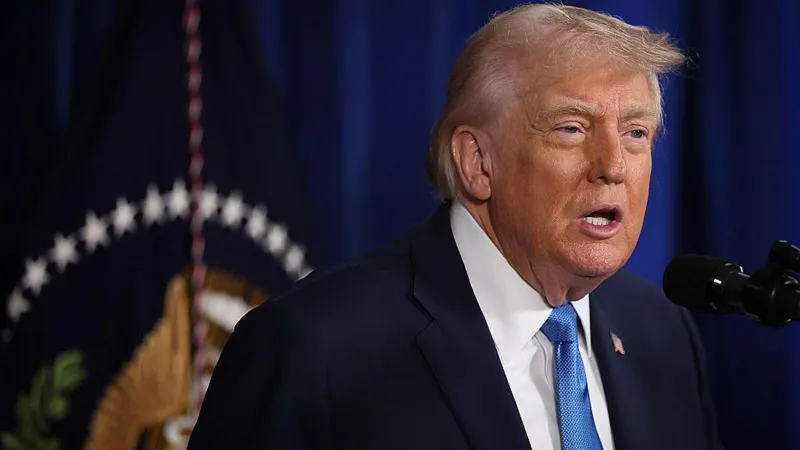

In a dramatic and unexpected move, U.S. President Donald Trump declared on January 6, 2026, that Venezuela would be “turning over up to 50 million barrels” of oil to the United States. This revelation has sent shockwaves through global energy markets, political circles, and diplomatic relations, raising questions about the future of U.S.–Venezuela relations and the geopolitical ramifications for global oil markets.
A New Chapter in U.S.–Venezuela Relations
Trump’s announcement marks a striking reversal in the longstanding political tensions between the U.S. and Venezuela. For years, relations between the two countries have been strained, with the U.S. imposing heavy sanctions on Venezuela’s oil industry in response to the leadership of President Nicolás Maduro. However, following recent developments in Caracas, including a controversial U.S. military operation aimed at toppling Maduro, the announcement signaled a new phase in the relationship.
In a series of public statements, President Trump confirmed that the Venezuelan government—under the control of interim authorities following Maduro’s ousting—had agreed to sell between 30 to 50 million barrels of crude oil to the United States. The oil, which had previously been tied up due to U.S. sanctions, would now be sold at market price, with the revenues reportedly to be managed by the U.S. government for the benefit of both the American and Venezuelan people.
Trump emphasized that the move was not about exploiting Venezuelan resources but rather about stabilizing both nations’ economies. “This oil is going to be sold, and the revenues are going to be used in a way that lifts up both nations,” Trump said, reinforcing the idea that this agreement would not only benefit the U.S. but also aid in Venezuela’s economic recovery.
The Market Impact: What It Means for Global Oil
The announcement has made waves in the global oil market, particularly as oil prices remained volatile heading into 2026. The idea of Venezuela—one of the world’s largest oil producers with the largest proven oil reserves—re-entering the global market is significant. Although 50 million barrels represents a small fraction of Venezuela’s total reserves, it still adds up to a notable amount in the context of global supply.
At current prices, which hover around $56 per barrel, the value of the 50 million barrels is approximately $2.8 billion. While this volume is not enough to single-handedly shift global supply dynamics, it is enough to prompt immediate reactions from market analysts. U.S. crude prices dipped slightly on the news, with traders predicting that the influx of Venezuelan oil could lead to more supply reaching U.S. refineries, which have long struggled with stagnant production growth.
Experts speculate that the decision could be a strategic one to ensure U.S. energy security and reduce its reliance on oil imports from the Middle East and other unstable regions. “The U.S. is looking to diversify its oil sources while maintaining a hold over the global supply chain,” said Oliver Greene, a senior commodities strategist. “While this is a win for America’s energy future, it also sends a strong message to rival powers, particularly China, that the U.S. is asserting itself in the Western Hemisphere.”
Political Reactions: From Support to Outrage
As expected, Trump’s announcement has sparked fierce debate within the political realm. Republican lawmakers have generally voiced support for the deal, with many praising it as a victory for U.S. energy independence and an example of American leadership. Senator Mark Reynolds (R-TX) lauded the move, stating that it would not only provide economic benefits but also help stabilize the region by offering a solution to Venezuela’s ongoing economic crisis.
“This is a win for American jobs, American energy independence, and the global energy market,” Reynolds said. “We’re stabilizing supplies and showing leadership at a time when energy volatility threatens economies worldwide.”
However, critics of the move have expressed concerns over its legality and the broader implications for international relations. Democrats, in particular, have accused the Trump administration of using heavy-handed tactics to seize control of Venezuelan resources. Representative Laura Mitchell (D-CA) condemned the agreement, describing it as an overreach that undermines Venezuela’s sovereignty.
“This is not energy policy — this is resource grabbing under the pretense of politics,” Mitchell stated. “The consequences will echo beyond the oil markets.”
International reactions have been similarly divided. China, which has been a key ally of Venezuela and its largest oil customer, condemned the move as a blatant violation of international law. European Union officials have called for dialogue and restraint, cautioning that such a bold shift in energy strategy could lead to significant diplomatic fallout.
Geopolitical and Economic Ramifications
The broader geopolitical and economic impact of this deal is still unfolding, but its potential consequences are profound. For the United States, the transfer of Venezuelan oil represents a strategic advantage in the ongoing battle for global influence over energy markets. The oil deal may also help stabilize domestic oil prices by increasing the supply of crude and offering more opportunities for U.S. refineries to process heavy crude—something the U.S. has struggled with in recent years.
The immediate implications for Venezuela, on the other hand, are more complex. While the deal offers a temporary solution to the country’s economic woes, it does not address the systemic issues within Venezuela’s oil industry, which has long been plagued by underinvestment, corruption, and a lack of infrastructure. Moreover, critics argue that Venezuela’s continued dependence on oil exports as the primary engine of its economy may ultimately hinder its long-term development and efforts to diversify.
In the short term, however, the deal is likely to provide some relief to Venezuela’s failing economy. With oil revenues directed to the U.S., there is potential for rebuilding the country’s shattered infrastructure and improving basic living conditions, assuming the arrangement is implemented transparently and effectively.
A New Phase in Energy Diplomacy
Ultimately, the deal between the U.S. and Venezuela signals a new era in energy diplomacy, one where political and economic considerations often intersect with the quest for energy security. As the global energy market continues to evolve, the balance of power will likely shift, with countries like Venezuela playing an increasingly central role.
While the full extent of the deal’s success remains to be seen, its impact on both nations—and on the global energy landscape—will be felt for years to come. Whether this marks a turning point in U.S.–Venezuela relations or merely a temporary shift in strategy will depend on the implementation of the deal and the diplomatic fallout from the broader international community.
For now, as President Trump’s bold decision reverberates around the world, the oil markets are watching closely, as are political leaders in Caracas, Washington, Beijing, and beyond.
For ongoing coverage of this developing story, follow ScopMagazine’s global politics and energy desk.