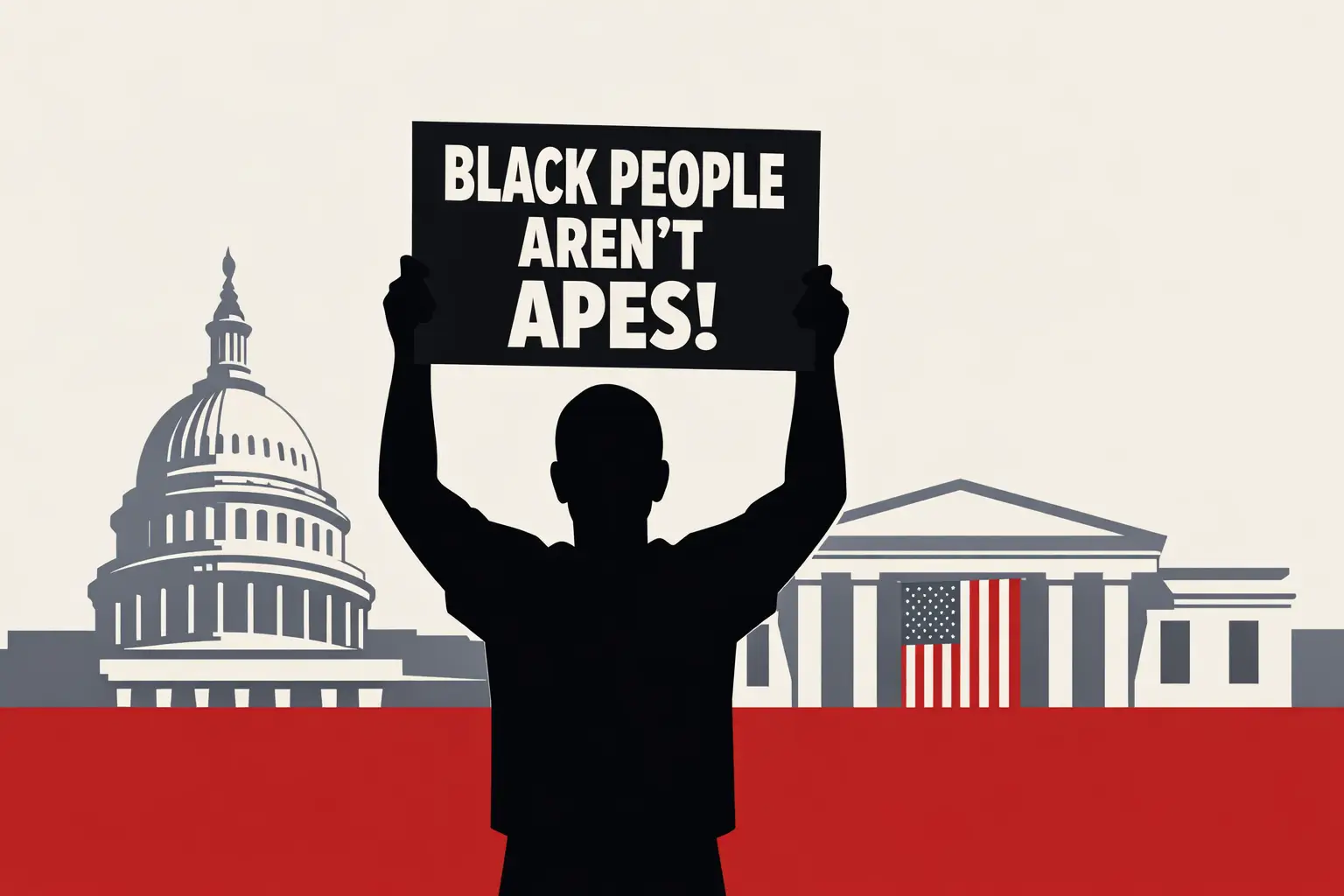

The State of the Union is usually built for big moments—applause lines, pointed pauses, and the kind of made-for-TV politics that travels fast online. But this year, the headline moment arrived almost immediately: Al Green, a Democratic congressman from Texas, stood inside the House chamber holding a protest sign that read “BLACK PEOPLE AREN’T APES!” and was quickly escorted out.
What made it explode across social media wasn’t only the removal—it was what the sign was responding to: a recent Truth Social post tied to President Donald Trump that depicted Barack and Michelle Obama as apes, a racist trope with a long history.
Why was Al Green escorted out of the State of the Union?
Al Green was escorted out after he held up a protest sign inside the House chamber, reading “BLACK PEOPLE AREN’T APES!” as President Trump entered to deliver the State of the Union. Republicans confronted him and attempted to block or pull down the sign, and House security staff removed him to restore order.
Key Takeaways
- Al Green staged a silent sign protest moments into the State of the Union.
- The sign referenced a Truth Social post depicting the Obamas as apes.
- Republicans confronted him and the sign was blocked from view; he was escorted out.
- GOP leaders signaled censure could be on the table again, after Green was censured last year.
What Happened Inside the Chamber
As President Trump entered the House chamber to begin the address, Al Green rose near the front and lifted a sign with a direct message: “BLACK PEOPLE AREN’T APES!”
Multiple Republicans moved in to confront him and prevent the sign from being visible. Reports described lawmakers trying to block it and attempts to grab or pull it down. Within roughly two minutes, House security staff escorted him out.
This is the kind of confrontation that instantly splits viewers into camps: some see a disruption of decorum, others see a protest aimed at forcing attention onto a deeper issue. Either way, it worked as a media moment—short, vivid, and impossible to ignore.
The Sign’s Message, and Why It Landed Hard
The sign wasn’t vague. It was a plain, blunt rejection of a racist idea—one that has been used historically to dehumanize Black people. The protest was tied to a social media controversy earlier in February, when a video posted to Truth Social depicted Barack and Michelle Obama as apes.
According to reporting, President Trump later condemned the video but refused to apologize, and said it was posted by a staffer; the post was eventually removed.
The Backstory: The Truth Social Post Controversy
To understand why Al Green chose that message and that moment, you have to zoom out to the weeks before the speech.
A video shared on Trump’s Truth Social account sparked outrage for depicting the Obamas as apes—something critics and civil rights advocates called plainly racist. Some Republicans also criticized the post, according to coverage of the backlash.
This wasn’t a minor internet squabble. It collided with the State of the Union’s symbolism: a nationally televised moment, inside the House chamber, meant to project institutional seriousness. Green’s protest was an attempt to force that controversy into the room where power is performed.
Why This Specific Trope Matters
Comparing Black people to apes is not “just edgy content.” It’s a dehumanizing stereotype with a documented racist history. That’s part of why Green’s phrasing was so direct—no slogans, no metaphors, no wink-and-nod.
A Familiar Clash: Protest vs. Decorum
There’s always a quiet tug-of-war at major political events:
- One side argues: This is a formal speech; disruptions degrade the institution.
- The other argues: Some moments demand moral clarity, even if it breaks the script.
In this case, Democratic leaders had reportedly urged members to avoid signs and maintain decorum—guidance that highlights how much party leadership wanted to control the visuals of the night.
But protests still happened—some through absence, some through alternative events, and some directly in the chamber.
What Made This Moment Different
A lot of political protest is designed to be interpreted. This one wasn’t. Al Green put the context right on the cardboard. That clarity is part of why the moment traveled so fast.
Could There Be Consequences? The Censure Question Returns
Republican leaders suggested that censure could be considered again.
Censure isn’t removal from office, but it’s a formal rebuke by the House. It’s a political punishment that lives forever in the record—and it can be used as a warning shot to other members who might be tempted to disrupt future addresses.
This matters because Green has been here before: he was censured last year after a disruption at a Trump speech.
What a Censure Typically Signals
In plain terms, censure usually communicates three things:
- The majority wants to set a line on chamber behavior.
- The incident is being framed as institutional, not personal—even when politics is driving it.
- The punishment is symbolic but politically useful for messaging and fundraising.
Whether Republicans pursue it again will depend on caucus appetite, media momentum, and whether leadership wants a clean “law-and-order in the chamber” storyline.
Context Timeline
- Early February 2026: Backlash erupts over a Truth Social video depicting the Obamas as apes; the post is later removed.
- Feb. 25, 2026: During the State of the Union, Al Green holds up a sign reading “BLACK PEOPLE AREN’T APES!” and is escorted out.
- After the disruption: Republicans float the possibility of renewed censure talk; attention turns to what the House does next.
What It Means and What Could Happen Next
| What Happened | Who Was Involved | Why It Matters | What Could Happen Next |
| Sign a protest during SOTU | Al Green; House security staff | Puts a racism controversy into the SOTU spotlight | House leadership debates formal response |
| Confrontation over the sign | Republicans near Green | Shows how quickly tensions can flare on live TV | New rules emphasis / stricter enforcement |
| Removal from the chamber | Sergeant-at-arms staff | Reinforces decorum expectations at high-profile events | Political fallout inside both parties |
| Reference to Truth Social post | Trump’s social media orbit; Obamas | Raises the stakes by linking the protest to a racist trope | Broader debate over political rhetoric |
| Censure talk resurfaces | GOP leaders, House members | Signals potential institutional punishment | Vote on censure possible, timing uncertain |
What to Watch Next
- Whether House Republicans formally introduce a censure resolution.
- How Democratic leadership publicly frames Green’s protest—principled stand or strategic headache.
- Any official statements clarifying chamber rules on signs and disruptions.
- Whether the Truth Social controversy continues to shape the broader news cycle.
- How the next major Trump address is policed—and protested.
The Bigger Picture: Why This Moment Will Stick
Political nights like the State of the Union are carefully staged. That’s why unscripted visuals matter so much. A sign is simple. A sign is shareable. A sign is instantly understood without audio.
That’s also why leadership on both sides tends to react sharply: the event isn’t just about policy, it’s about the story people tell afterward.
For supporters of Al Green, the protest reads like moral urgency—an unwillingness to let a racist dehumanizing trope pass without confrontation. For critics, it reads like a breach of decorum that turns a formal address into a spectacle. The House now has to decide whether this becomes just a viral clip—or a formal disciplinary episode.
And there’s another reason it resonates: it exposes how online political content doesn’t stay online. What gets posted, shared, and defended in digital spaces can end up shaping real-world confrontations in the most official rooms in the country.
FAQ
1) Why did Al Green bring a sign to the State of the Union?
He used the sign to protest a recent Truth Social video tied to President Trump that depicted Barack and Michelle Obama as apes. The sign was meant to directly reject that racist trope.
2) What did the sign say?
The sign read: “BLACK PEOPLE AREN’T APES!” It was visible inside the House chamber as the speech began.
3) What happened when he raised it?
Republicans confronted him and tried to block the sign from view; there were attempts to pull it down. House security staff then escorted him out.
4) Was this Al Green’s first disruption at a Trump speech?
No. He was also removed during a Trump address last year, and the House voted to censure him afterward.
5) What is “censure,” and could it happen again?
Censure is a formal reprimand by the House. Republican leaders have suggested it could be considered again after this disruption, but any action depends on what leadership brings forward.
6) Did Democrats encourage protests during the speech?
Reports indicated Democratic leadership urged members to maintain decorum and not bring signs—though some members still protested in different ways.
7) Did Trump apologize for the Truth Social video?
Coverage reported Trump condemned the video but did not apologize, and said it was posted by a staffer; the post was later removed.
8) Why did this moment get so much attention?
It happened at the most watched part of the night—right as the speech began—and the message was instantly understandable on camera, making it highly shareable.
Conclusion
Whether you view it as disruption or a necessary protest, Al Green forced a national audience to confront a message that was unmistakable—and impossible to “both-sides” into background noise. With censure talk back on the table and tensions inside Congress still running high, this moment won’t fade quickly.
For sharper, human-first coverage that explains the headline and the context, explore more stories on ScopMagazine.